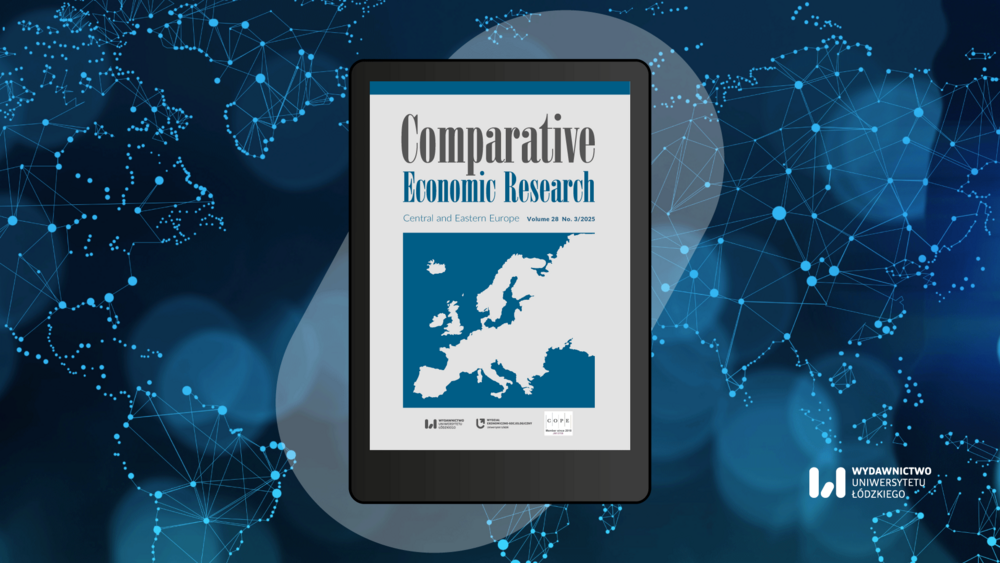
We are pleased to announce the release of the latest volume of Comparative Economic Research, which addresses current economic and financial challenges from both a European and global perspective.
This international scholarly journal engages with the most pressing economic and financial issues of our time. In the newest issue, researchers from various countries explore topics related to sustainable development and finance in Europe.
The following articles are included in Vol. 28 No. 3 (2025):
Fiscal (Un)Sustainability in Practice: Local Government Finance in Visegrad Economies – Tomasz Uryszek, Agnieszka Kłysik-Uryszek
The objective of this study is to evaluate the fiscal sustainability of Local Government Units (LGUs) in the Visegrad Group economies (Czechia, Hungary, Poland, and Slovakia; the V4), focusing on three key hypotheses: (1) LGUs in the V4 are involved in so-called Ponzi games; (2) the adverse effects of such games intensified during the economic recession, the COVID-19 crisis, and the war in Ukraine; (3) primary budget balances of LGUs impact the stabilization of their debt levels. The study spans 2001–2022, encompassing significant economic disruptions. The analysis utilizes fiscal sustainability assessments, including the primary gap indicator and criteria for Ponzi-like behaviors. Key findings reveal varying degrees of fiscal sustainability across the V4, with notable disparities in resilience and debt management. The implications and recommendations emphasize the need for enhanced fiscal discipline, targeted policy adjustments, and transparent governance frameworks to address identified vulnerabilities. The paper offers a comprehensive examination of LGU fiscal sustainability in Central European economies, offering insights for policymakers and enriching the discourse on public finance management in post-transitional economies.
Organic Animal Products in the EU to Support Sustainable Consumption – Natalia Szubska
A critical analysis of the research discourse on the development of organic farming is imperative if it is to contribute to the spread of sustainable consumption patterns, as indicated in the European Green Deal (EGD). However, there is a notable dearth of research from a macroeconomic perspective. What and how much we consume affects human health and the environment. Therefore, there is a need to increase consumer awareness of the consequences of food choices, as organic animal products can contribute to sustainable consumption and production. The study aims to determine the level of development of the production of organic animal products in European Union (EU) countries. Synthetic indicators of the development level of EU countries in 2016 and 2020 were constructed based on the Principal Components Approach (PCA) using Eurostat data. A survey and literature review shows that countries at the top of the ranking, such as Denmark, Sweden, Finland and Austria, have active policies to support the development of organic agriculture on both the supply and demand sides. On the other hand, a divergence in the factors that influence the development of organic agriculture was also observed in the top-ranked countries. Therefore, the development of organic agricultural production, including organic animal products, requires the diffusion of experiences across the EU to support the multifaceted OAFR (organic agriculture and food research) paradigm and the Sustainable Development Goals.
Evaluating the Suitability of the Simplified Pairs Trading Strategy for Short-term Equity Market Trading – Julija Mosina, Grigorij Žilinskij
Pairs trading has been a successful tool for traders since its inception in the 1980s and has evolved significantly with the introduction of algorithmic, machine, and AI trading. This evolution has complicated the implementation of this strategy that traditionally benefits institutional or specialized investors. Despite this, the simplicity of pairs trading remains accessible, indicating potential benefits for ordinary traders. By focusing on the strategy’s fundamental principles and employing a real-time market test on a popular trading platform, the study aims to reveal its applicability and efficacy for short-term equity trading. Utilizing basic trading platform tools and Excel functions, the research aims to demonstrate a simplified approach to pairs trading. The findings will provide insights into the strategy’s effectiveness, providing non-expert traders with a viable approach to navigate today’s volatile markets through a simplified yet effective pairs trading model. The experiment’s findings highlight varying performances across different stock pairs, with notable differences in volatility. While five out of 11 pairs achieved positive returns, only two met the closure criteria within the short-term horizon, suggesting that a longer trading period and a more diversified pair’s portfolio may be necessary to fully capture expected price convergence.
The Green Economy for a Sustainable Future: Experience from the Visegrad Group Countries – Roman Klimko
The objective of this paper is to identify the significance of the green economy for a sustainable future and compare the situation and developments in achieving the European Green Deal (EGD) in the Visegrad Group (V4) countries. To achieve this objective, the paper focuses on the challenges, risks and opportunities of implementing green economy policies. Comprehensive data analysis is conducted, and a European Green Deal Index (EGDI) for the V4 countries is developed. The Eurostat database is used to monitor 18 key indicators in the V4 countries from 2015 to the latest year available. The results show that Slovakia is the best-performing V4 country with the highest EGDI score, while Poland shows the most significant improvement, mainly in the category Enabling a green and just transition. Between 2015 and 2023, Slovakia and Czechia experienced negative trends in the percentage of the population unable to keep their home adequately warm for financial reasons. The paper highlights the social dimension of the EGD and the green economy as well as the importance of a just transition concept across the whole European Union since increased household spending on the green transition could affect public support.
The Role and Significance of EU Guidelines on Non-financial Reporting for SMEs – Paweł Modrzyński, Grażyna Voss
This study investigates the role and impact of non-financial reporting (NFR) regulations on small and medium-sized enterprises (SMEs) in the European Union. While large enterprises are the primary focus of directives such as the Non-Financial Reporting Directive (NFRD) and the Corporate Sustainability Reporting Directive (CSRD), SMEs are increasingly affected due to supply chain dependencies and financial incentives. The research aims to assess SME awareness, challenges, and expected benefits related to NFR adoption.mThe study is based on an empirical survey of 151 SMEs in the Kuyavian-Pomeranian Voivodeship in Poland, utilizing statistical methods such as correlation analysis and regression modeling to evaluate attitudes toward compliance and perceived barriers. The findings reveal that while SMEs acknowledge the growing relevance of NFR, resource limitations and lack of expertise hinder effective implementation. Nevertheless, SMEs that have proactively adopted NFR practices report benefits, including enhanced stakeholder relationships and a competitive market advantage.The study highlights the necessity for targeted policy interventions, including financial support, simplified compliance frameworks, and dedicated training initiatives to facilitate SME adaptation to sustainability reporting standards. This research contributes to the ongoing discussion on sustainability reporting by focusing on SMEs, a sector often neglected in NFR policy discussions. The study also provides empirical insights into how regulatory developments shape SME behavior, offering recommendations for policymakers on supporting sustainability transitions in the SME sector.
The Pan-European Personal Pension Product – Managers’ Challenges and Savers’ Expectations – Krzysztof Waliszewski, Antoni Kolek, Przemysław Barankiewicz
The Pan-European Personal Pension Product (PEPP) is a strategic initiative of the European Union (EU) aimed at creating a harmonized, portable pension savings framework that addresses the challenges of population aging, increased labor mobility, and the widening pension gap across Member States. This article investigates the implementation and performance of the PEPP in four EU countries – Poland, Slovakia, Croatia, and the Czech Republic – through a mixed-methods research design. The study combines a legal and comparative analysis of national pension systems with qualitative interviews conducted with PEPP fund managers and quantitative surveys of PEPP savers. The findings reveal significant disparities in regulatory approaches, tax treatment, and supervisory frameworks between countries, which affect both the attractiveness and functionality of PEPP. Despite the shared design principles of transparency, safety, and cost-efficiency, savers’ expectations differ notably across countries – especially in relation to customer service, information delivery, and minimum return expectations – while also being shaped by sociodemographic factors. The qualitative research highlights that fund managers face challenges such as regulatory fragmentation, high administrative burdens, and competition from national products with more favorable tax treatment or employer-based incentives. At the same time, digital tools and passive investment strategies are seen as key to enhancing PEPP’s scalability and efficiency. The article concludes that for PEPP to succeed as a truly pan-European product, further regulatory harmonization, consistent tax incentives, and comprehensive financial education efforts are essential. The authors also propose that increased provider competition and adaptive national policies could accelerate the product’s uptake. The study offers practical insights for EU policymakers, national regulators, and financial institutions aiming to promote inclusive and sustainable retirement savings across the continent.
The Saving–Investment Relationship Re-visited: Capital Mobility and Current Account Deficit Sustainability – Valeryia Yersh
The study examines the degree of current account deficit (CAD) sustainability and capital mobility for a panel of 97 countries over the period 1980–2020. To this end, the study adopts a novel interpretation of the Feldstein–Horioka coefficient in the context of CAD sustainability and examines the relationship between savings and investment using the Dynamic Common Correlated Effects Mean Group (DCCEMG) estimator. The findings reveal that all country groups exhibit “weakly” sustainable CADs. The estimates of the short-run coefficients reveal that short-run capital mobility is high in all country groups, whereas long-run capital mobility is relatively moderate or low. The rolling-window analysis shows that the 2007–2008 global financial crisis caused a significant drop in both capital mobility and CAD sustainability. In the post-crisis period, short-run capital mobility and CAD sustainability remained on a downward trend in most regions, whereas long-run capital mobility started slowly recovering. By providing a comprehensive regional analysis across six major world regions, this study contributes to the literature by shedding light on the evolving dynamics of international capital flows and regional variations in external balance sustainability.
Enhancing Resilience in International Supply Chains: The Role of Sustainable Development in a VUCA World – Grażyna Kędzia, Blanka Tundys, Tomasz Wiśniewski, Beata Wieteska-Rosiak
In today’s VUCA (Volatility, Uncertainty, Complexity, Ambiguity) world, which exerts strong pressure on international and global supply chains, academia and business are actively seeking new strategies to foster their sustainable and uninterrupted development. The results of our study, using statistical methods such as analysis of variance, show that the implementation of sustainable development principles in supply chain management positively affects the resilience of supply chains to sustainability risk across the pre-disruption, during-disruption and post-disruption phases. This, however, is contingent on a process-based approach to supply chain management and a high level of managerial awareness of the various types of risks to supply chains. Furthermore, our findings confirm that the key organizational characteristics are significant determinants of this resilience. Specifically, we observed that company size, the origin of the capital, and the degree of internationalization all affect supply chain resilience across the three disruption phases. Sustainable and resilient (SUS-RES) supply chains, which employ proactive, concurrent, and reactive approaches, are particularly noticeable in the supply chains of large enterprises with foreign capital or foreign branches. This suggests that managing international supply chain sustainably can also improve their resilience.
The issue presents a wide spectrum of research – from public finance in the Visegrad countries, through investment strategies and the green economy, to challenges related to non-financial reporting and the resilience of global supply chains.
All articles are available online. Link to the full journal HERE.
We invite you to read and reflect on the economy of the future!