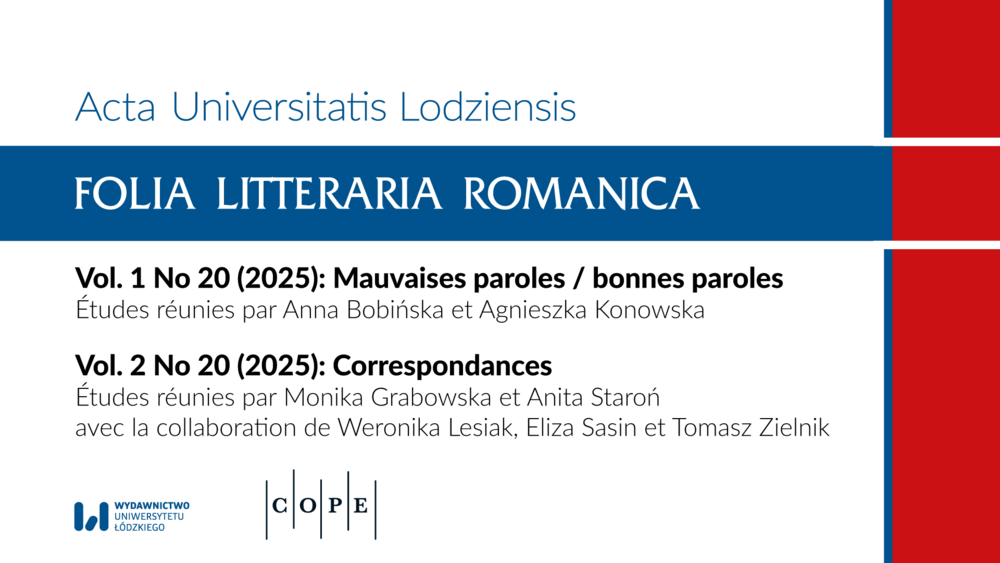
The journal presents two thematic volumes devoted to contemporary linguistic, literary, and cultural phenomena – from “good” and “bad” words to literary correspondences.
This issues features:
Vol. 1 No. 20 (2025): Mauvaises paroles / bonnes paroles:
Formation of “Good” and “Bad” Words in French
Anna Bochnakowa
Zola and the Bad Word: From Letters to Fiction, a Poetics of Alterity
Élise Cantiran
Evolution of Neutral, Positive, and Negative Designations in Skyrock Radio Talk Shows (2003-2023)
Anne-Caroline Fiévet
Enter Lil Boël’s World. Shown in the Preface to La Fosse Commune des Misères (1942)
Anne Gensane
Etymology of Pataouète Insults and Verbal Offenses
Jean-Pierre Goudaillier
Triple buse, cervelle de moineau and poule mouillée – Bird Names as Insulting Terms in Familiar and Argotic French
Stéphane Hardy
Collocational Phrasemes Adj comme SN as Ways to Demean Someone
Małgorzata Izert
Evaluation and Affectivity in Streaming – subjectivèmes used by French and Polish Video Game Streamers
Agnieszka Janion
Insulting Someone’s Intelligence: Offensive Speech Based on Comparisons in the (avoir) le QI d’un(e) N/ (mieć) IQ NGén (avoir) le QI d’un(e) N/ (mieć) IQ NGén (‘(to have) the IQ of an N’) form in French and in Polish
Tomasz Januchta, Ewa Pilecka
Neological Verbs with Negative and Positive Connotations: A Formal and Pragmatic Analysis
Filip Kolecki
Use of Insults in French and Czech: Analysis Based on a Questionnaire
Radka Mudrochová, Tomáš Závodský, Jana Urbanová
Good and Bad Talk in Rap: Pragmatic Analysis of French and Polish Lyrics (2020-2024)
Andrzej Napieralski, Lena Czerwińska
Terminology of Modern Slang: About the Axiology of the langue verte
Laurent Canal, Alena Podhorná-Polická
Words of Violence in Suburban Language: Patterns Shaped by Male Domination in the Novels of Authors from Immigrant Backgrounds
Olga Stepanova Desfeux
Saying Good Things, Saying Bad Things in Hungarian Youth Slang
Dávid Szabó, Máté Kovács
Quoicoubeh, Trap or Mockery?
Camille Vorger
Metaphorical Representations of Pandemic-Related Phenomena in the ‘Denialist’ Discourses of COVID-19
Agnieszka Woch
Foreword
Jean-Pierre Goudaillier, Anna Bobińska
Does Rewriting Dictionaries Make Sense? A polemic Article about Agnieszka Piela’s Book Literature as a Source of Idiomatic Expressions: A Dictionary, UŚ Publishing, Katowice 2024
Dariusz Bralewski
Vol. 2 No. 20 (2025): Correspondances:
The Dialectic of “Non-Correspondences” in Communication
Petr Kyloušek
Describing Art, Describing Nature: Correspondences in the Work of Francis Poictevin
Eliza Sasin
The Correspondences Between Fiction and Non-Fiction in the Work of Camille Pert
Weronika Lesiak
The Intertextual Play – Correspondences in Louis-Ferdinand Céline’s The Journey to the End of the Night
Wojciech Trembaczowski
Vincent Jouve and François Mauriac: Cross-examined Views on the Character
Klaudia Kaczmarek
Between Resonances and Legacies: Literary Correspondences in Vie et mort d’un étang by Marie Gevers and Il pleut dans ma maison by Paul Willems
Karolina Tymura
Space and Time in the Theatre of Matei Vișniec: Strategies of Dramaturgical Exploitation
Abdellah Zine El Abidine
Correspondences Between the Original Text and the Polish Translation of The Legend and the Heroic, Joyous and Glorious Adventures of Ulenspiegel and Lamme Goedzak in the Land of Flanders and Elsewhere by Charles De Coster
Tomasz Zielnik
“The Last Generation Able to Change Everything” – Thematic and Formal Correspondences Between Polish and French Slogans Taken from the Placards of Young Environmental Activists
Michalina Buler
The Influence of the Media Linguistic Imaginary on Foreign Language Learning in Primary and Secondary Schools: an Analysis of Adjectives in the Press Through the Czech National Corpus
Moïse Lemonnier
Geminate Consonants and Stress Accent in Italian as a Foreign Language: the Case of Advanced French-Speaking Learners
Karol Niewiadomski
The French Plus-Que-Parfait and the Slovak Antepréteritum: a Forgotten Temporal Correspondence
Zuzana Puchovská
Strategies Used by Learners to Develop Their Plurilingual Competence in Intercomprehension Reading
Marta Ściesińska
The Forms of Expression of French Language Students’ Cognitive Engagement in a Listening Comprehension Task
Łukasz Ściesiński
Foreword
Monika Grabowska, Natalia Nielipowicz, Piotr Sadkowski, Anita Staroń
Cahiers Octave Mirbeau, n° 30, Classiques Garnier, 2023, 434 p.
Laure Lévêque
Links to both issues can be found HERE and HERE.
All articles are published in French.
Enjoy the reading!